Ngành
Lý do Apple chọn Việt Nam đặt trung tâm đào tạo đầu tiên tại Đông Nam Á
(giờ Việt Nam)
Tóm tắt AI
Apple mở trung tâm đào tạo tại Việt Nam nhằm hỗ trợ người lao động thích nghi với làn sóng tự động hóa và sự phát triển mạnh mẽ của AI trong sản xuất.
Chính văn · Bản dịch AI

Apple has just opened its first direct training center in Southeast Asia for supply chain employees, in collaboration with Hanoi University of Science and Technology (HUST) right on the university campus. According to Apple, the center will begin operations this autumn.
At the launch event, Sarah Chandler, Apple’s Vice President of Environment and Supply Chain Innovation, stated that this training center was established to complement the online training programs the company has been implementing for many years with in-person learning.
"We want supply chain workers to have the opportunity to build their own learning paths, development, and career orientation," Ms. Chandler shared with Tri Thuc - Znews, adding that more than 10 million supplier employees globally have accessed the company's educational programs over the past few years.
We want supply chain workers to have the opportunity to build their own learning paths, development, and career orientation.
Sarah Chandler
Vice President of Environment and Supply Chain Innovation, Apple
Associate Professor Ta Hai Tung, Vice President of Hanoi University of Science and Technology and Dean of the School of Information and Communication Technology, said the university supported the project as soon as the partnership proposal was received, as it aligns with the mission of popularizing digital skills that the university has pursued for many years.
"Workers in factories are the group that will soon be affected by the automation process. If trained with the right skills, they will quickly advance in their careers and not be left behind," Mr. Tung shared.
A training model to prepare workers for the future
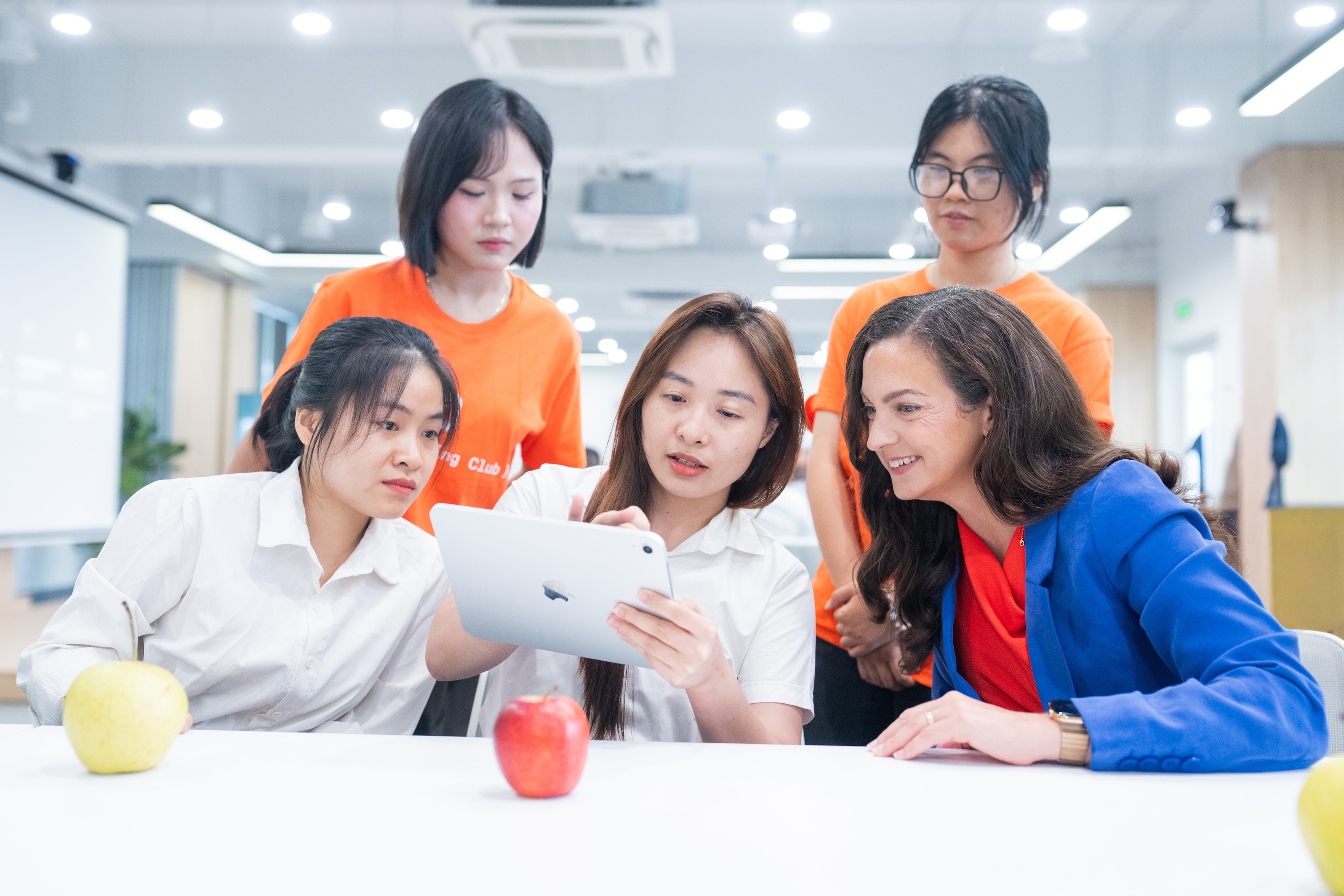
Ms. Sarah Chandler attends a training session and listens to students present their project on creating an object classification application.
According to Ms. Chandler, this is Apple's 4th direct training center in the world, following facilities in the US, China, and India, all applying a very high standard of operation. She also highly values the partnership with Hanoi University of Science and Technology, a school renowned for its training quality.
The training curriculum at the center includes foundational skills in smart manufacturing, robotics, and automation, along with Swift programming, taught by a team of professional educators. In addition to technical skills, students also have access to courses on soft skills for leadership and line supervisor training.
Ms. Chandler said the company plans to open more courses on automation, robotics, and artificial intelligence in the near future, alongside the application programming course currently being implemented. These are contents that Apple representatives believe will help personnel working in the supply chain prepare for high-tech jobs in the future.
"We want to ensure that we provide every person who makes Apple products with the learning opportunities and technology to reach their full potential," Ms. Chandler shared.
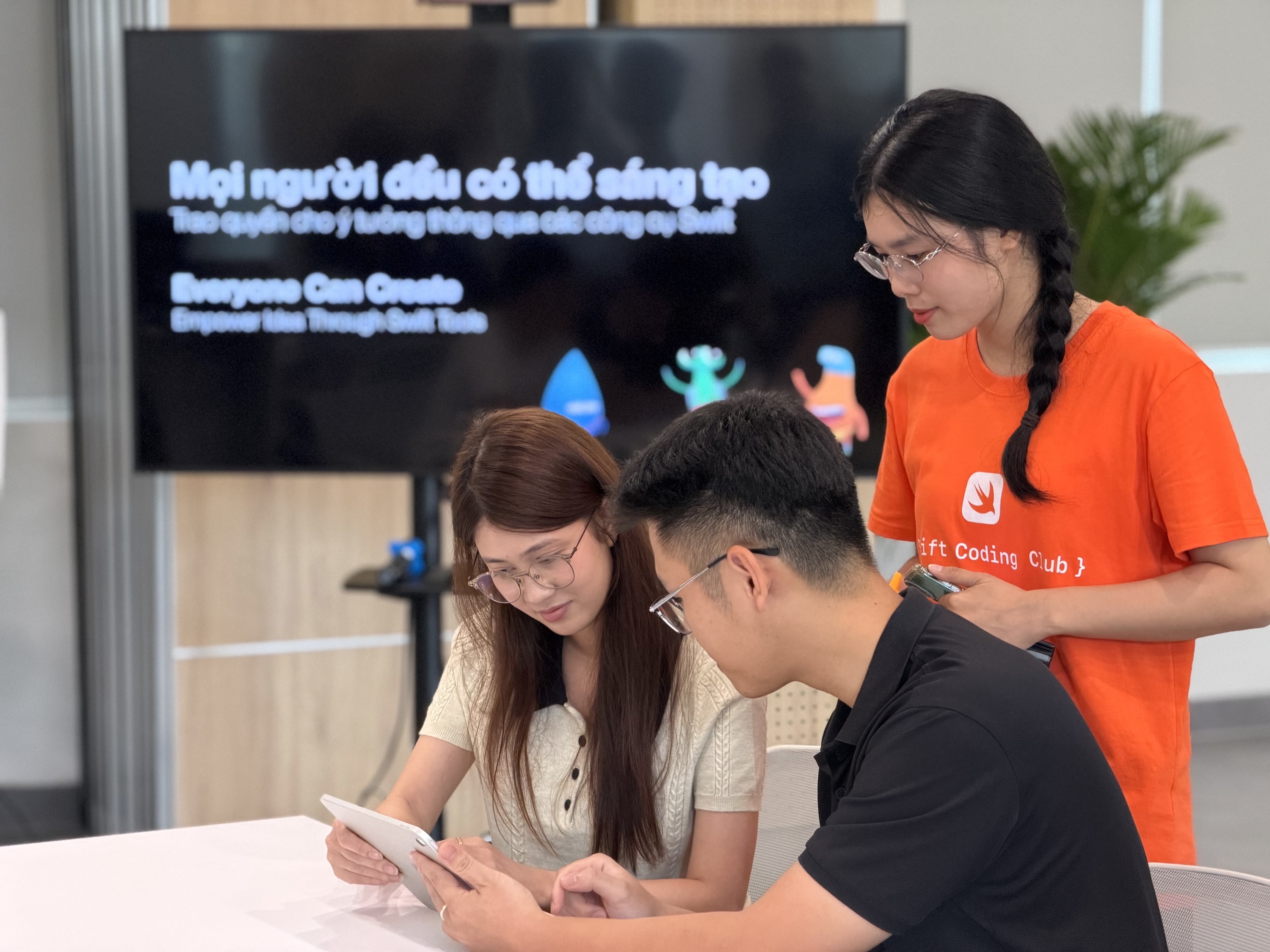
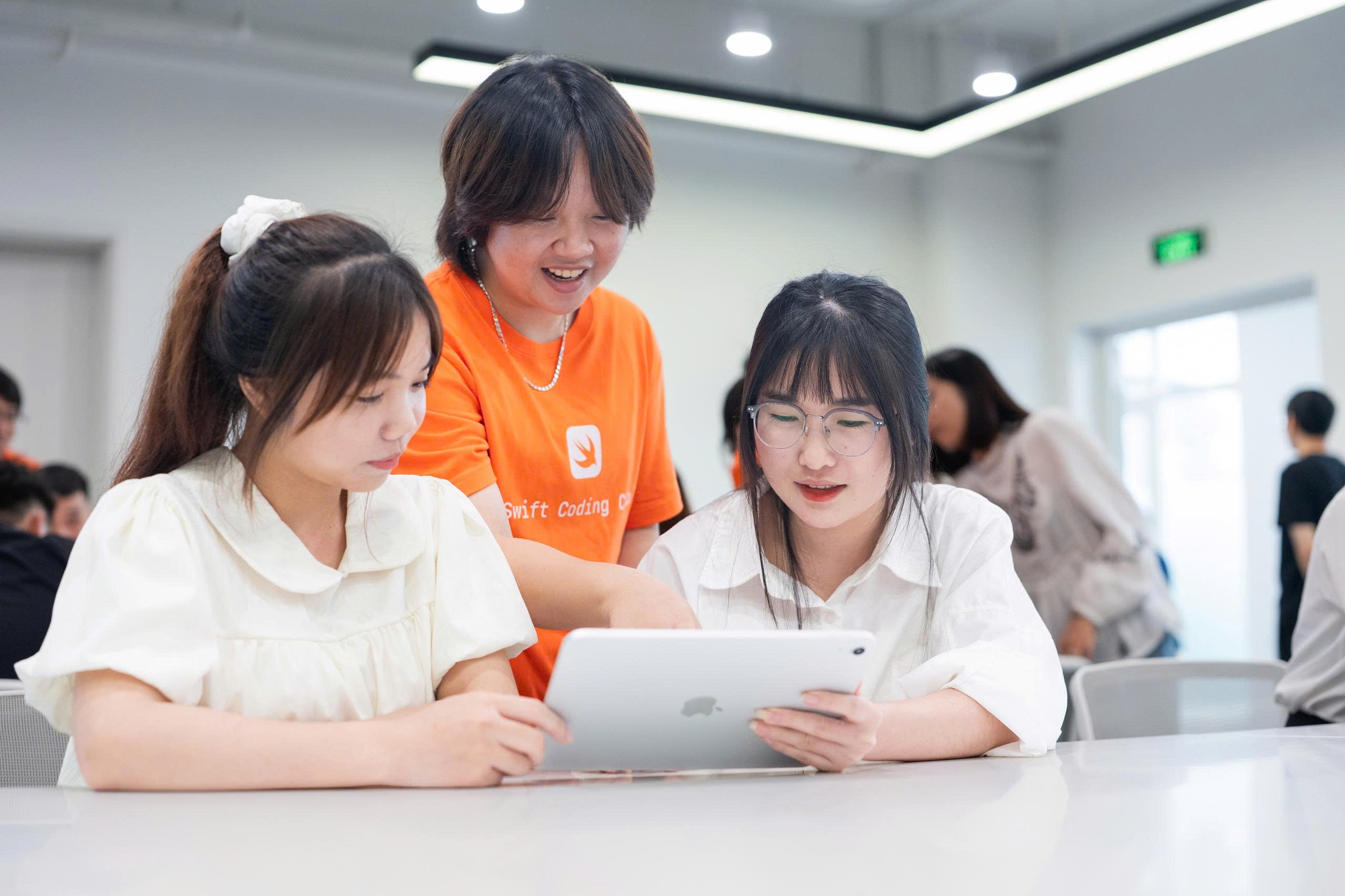

Students in a basic Swift programming training class at the training center established by Apple in partnership with Hanoi University of Science and Technology, August 27.
Associate Professor Ta Hai Tung said that in the triple-helix cooperation model (government, university, and enterprise), the university plays the role of knowledge transfer, while the enterprise receives and applies it to actual production. According to him, this is a direction many countries have successfully applied, consistent with Resolution 57 on breakthroughs in scientific development, technology, innovation, and national digital transformation, and Resolution 71 on breakthroughs in education and training of the Politburo.
"By partnering with Apple, we can immediately support the retraining and upskilling of the workforce to adapt to the new labor market," Mr. Tung assessed.
According to the official announcement, the center's course suite will be expanded to more than 30 supplier facilities across the country, part of Apple's $50 million global supplier employee development fund, which has organized more than 9 million training sessions since 2022. Beyond vocational skills, the program also includes content on labor rights, mental health, and early disease screening. Specifically, for vocational training for people with disabilities, more than 49,000 employees have participated at over 70 facilities since 2022.
Learning to go further
Associate Professor Ta Hai Tung, Vice President of Hanoi University of Science and Technology.
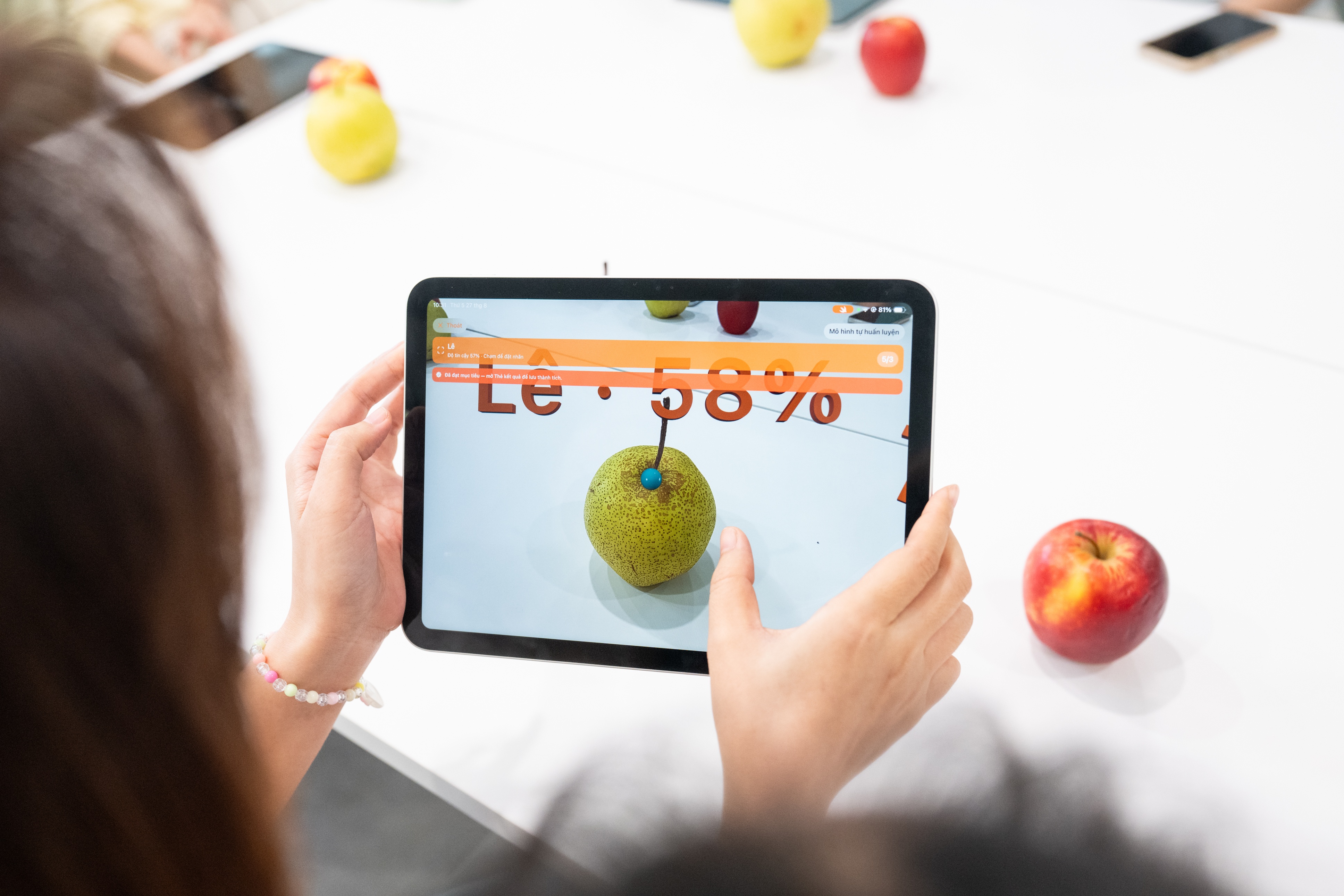
At the first experiential class on the basics of programming with Swift, Apple representatives witnessed personnel who had never coded before create an object recognition application after less than an hour of familiarization on an iPad. Ms. Chandler believes this demonstrates the effectiveness of in-person training, as those who have learned can return and teach their colleagues.
"I think it's great that people not only have the opportunity to learn new skills but also gain leadership abilities to teach those skills to others," Ms. Chandler said.
Giang Thanh Pho, 25, a Mechatronics graduate from Hanoi University of Science and Technology, is currently an equipment engineer at Lens Technology Vietnam. From being in charge of plastic molding, he has been rotated through various stages such as operating CNC machines or product polishing, helping him gain a deeper understanding of the production process.
Sharing at the training center launch, Pho expressed his desire to participate in more in-depth robotics training courses to apply to his actual work.
Lam Van Tu, 30, also shared the difficulties of being born deaf while working. Mr. Tu worked as a garment worker for many years, his job confined to a single stage and almost unable to communicate with managers because no one knew sign language. More than once, he witnessed colleagues being scolded, even though he himself could not hear those words.
About 6 months ago, Tu was introduced by a friend who is also deaf to Goertek Vietnam. Here, he learned that people with disabilities like him could also be provided with conditions to work equally and interact with colleagues. The company provides sign language interpreters to support communication. After joining, he participated in two internal training courses: one on skills in production stages other than packaging, and one on how people with and without disabilities can coordinate at work.
"When I joined the new company, I felt like my life had turned a new page," Mr. Tu, currently a packaging employee at Goertek, shared through a sign language interpreter. A stable income helps him send money home to build a house for his family, instead of just covering his own expenses as before.
Mr. Tu's story is also linked to another program that Apple maintains in parallel with the education center: vocational training specifically for people with disabilities in the supply chain, with the goal of opening more suitable job positions for this group of workers. Currently, the workshop where Mr. Tu works has 3-4 colleagues who are also deaf, and he hopes the company will hire more hearing-impaired workers so the group has more opportunities to communicate with each other.
I hope we can leverage the youth and creativity of young Vietnamese people so they can participate more deeply in the supply chain as well as the value chain of the world's leading corporations.
Associate Professor Ta Hai Tung
Vice President of Hanoi University of Science and Technology
Despite different circumstances, Tu and Pho both spoke about the importance of learning to push themselves forward. For Pho, it is an opportunity to improve skills while also training new employees. As for Tu, he believes that he must learn to have the capacity to help others like himself.
Looking from the perspective of training management, Mr. Ta Hai Tung believes that the Vietnamese workforce is inherently young and capable of rapid absorption, so if equipped with the right skills, they can fully adapt to the increasingly rapid technological changes in the manufacturing industry, participating more deeply in the supply chain and value chain of the world's leading corporations, instead of passively being affected by the automation process.
Ms. Chandler views this issue on a broader scale. According to her, many years of implementing educational programs in the supply chain show that learning can change the career path and life of workers, while helping them bring the skills and initiatives they have learned back to their communities. That is also why, according to her, the center in Hanoi does not stop at training skills for current jobs, but also aims to prepare workers for higher-tech jobs in the future.
Bài viết được AI dịch và tổng hợp tự động từ Znews Công nghệ. Liên kết bài gốc ở phía trên. AIHOT.vn luôn dẫn nguồn đầy đủ — nếu bạn thấy điểm cần chỉnh sửa, hãy gửi ý kiến tại trang phản hồi.